A
comment is an explanation or description of the source code of the
program. It helps a developer explain logic of the code and improves
program readability. At run-time, a comment is ignored by the compiler.
There are two types of comments in C:
1)
A comment that starts with a slash asterisk /* and finishes with an
asterisk slash */ and you can place it anywhere in your code, on the
same line or several lines.
2) Single-line Comments which uses a double slash // dedicated to comment single lines
Example Single Line Comment
// single line comment example
Here is an example of comments type
// C program to demo
// Single Line comment
#include <stdio.h>
int main(void)
{

 // This is a single line comment
 printf("Guru99");
 return 0;  // return zero
}
Example Multi Line Comment
/* Sample Multiline Comment
Line 1
Line 2
….
…
*/
Example Multi Line Comment
#include <stdio.h>
int main() {
/* in main function
I can write my principal code
And this in several comments line */
int x = 42; //x is a integer variable
printf("%d", x);
return 0;}
Why do you need comments?
A good programmer
who writes codes understood by a human is better than a programmer who
generates codes understood only by the machine.
So, it is highly
recommended to insert comments to your code because it is good
programming practice. Comments do not affect a program because the
compiler ignores them.
Comments help the developer understand the logic/algorithm of the code if he revisits it after a long time.
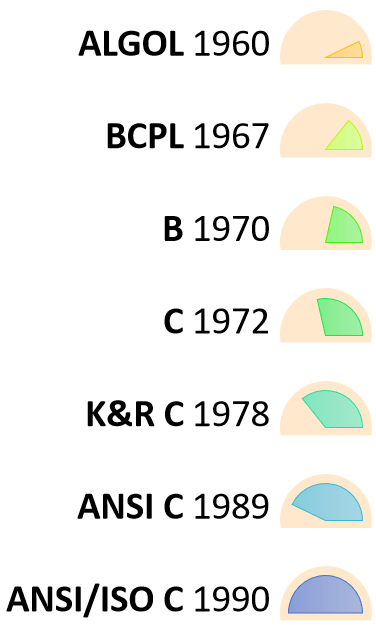
The base or father of programming
languages is 'ALGOL.' It was first introduced in 1960. 'ALGOL' was used
on a large basis in European countries. 'ALGOL' introduced the concept
of structured programming to the developer community. In 1967, a new
computer programming language was announced called as 'BCPL' which
stands for Basic Combined Programming Language. BCPL was designed and
developed by Martin Richards, especially for writing system software.
This was the era of programming languages. Just after three years, in
1970 a new programming language called 'B' was introduced by Ken
Thompson that contained multiple features of 'BCPL.' This programming
language was created using UNIX operating system at AT&T and Bell
Laboratories. Both the 'BCPL' and 'B' were system programming languages.
In
1972, a great computer scientist Dennis Ritchie created a new
programming language called 'C' at the Bell Laboratories. It was created
from 'ALGOL', 'BCPL' and 'B' programming languages. 'C' programming
language contains all the features of these languages and many more
additional concepts that make it unique from other languages.
'C'
is a powerful programming language which is strongly associated with
the UNIX operating system. Even most of the UNIX operating system is
coded in 'C'. Initially 'C' programming was limited to the UNIX
operating system, but as it started spreading around the world, it
became commercial, and many compilers were released for cross-platform
systems. Today 'C' runs under a variety of operating systems and
hardware platforms. As it started evolving many different versions of
the language were released. At times it became difficult for the
developers to keep up with the latest version as the systems were
running under the older versions. To assure that 'C' language will
remain standard, American National Standards Institute (ANSI) defined a
commercial standard for 'C' language in 1989. Later, it was approved by
the International Standards Organization (ISO) in 1990. 'C' programming
language is also called as 'ANSI C'.
History of C
Languages
such as C++/Java are developed from 'C'. These languages are widely
used in various technologies. Thus, 'C' forms a base for many other
languages that are currently in use.
Where is C used? Key Applications
'C' language is widely used in embedded systems.
It is used for developing system applications.
It is widely used for developing desktop applications.
Most of the applications by Adobe are developed using 'C' programming language.
It is used for developing browsers and their extensions. Google's Chromium is built using 'C' programming language.
It is used to develop databases. MySQL is the most popular database software which is built using 'C'.
It
is used in developing an operating system. Operating systems such as
Apple's OS X, Microsoft's Windows, and Symbian are developed using 'C'
language. It is used for developing desktop as well as mobile phone's
operating system.
It is used for compiler production.
It is widely used in IOT applications.
Why learn 'C'?
As
we studied earlier, 'C' is a base language for many programming
languages. So, learning 'C' as the main language will play an important
role while studying other programming languages. It shares the same
concepts such as data types, operators, control statements and many
more. 'C' can be used widely in various applications. It is a simple
language and provides faster execution. There are many jobs available
for a 'C' developer in the current market.
'C'
is a structured programming language in which program is divided into
various modules. Each module can be written separately and together it
forms a single 'C' program. This structure makes it easy for testing,
maintaining and debugging processes.
'C' contains 32 keywords, various data types and a set of powerful built-in functions that make programming very efficient.
Another
feature of 'C' programming is that it can extend itself. A 'C' program
contains various functions which are part of a library. We can add our
features and functions to the library. We can access and use these
functions anytime we want in our program. This feature makes it simple
while working with complex programming.
Various compilers are available in the market that can be used for executing programs written in this language.
It
is a highly portable language which means programs written in 'C'
language can run on other machines. This feature is essential if we wish
to use or execute the code on another computer.
How 'C' Works?
C
is a compiled language. A compiler is a special tool that compiles the
program and converts it into the object file which is machine readable.
After the compilation process, the linker will combine different object
files and creates a single executable file to run the program. The
following diagram shows the execution of a 'C' program
Nowadays,
various compilers are available online, and you can use any of those
compilers. The functionality will never differ and most of the compilers
will provide the features required to execute both 'C' and 'C++'
programs.
Following is the list of popular compilers available online:
Clang compiler
MinGW compiler (Minimalist GNU for Windows)
Portable 'C' compiler
Turbo C
Summary
'C' was developed by Dennis Ritchie in 1972.
It is a robust language.
It is a low programming level language close to machine language
It is widely used in the software development field.
It is a procedure and structure oriented language.
It has the full support of various operating systems and hardware platforms.
Many compilers are available for executing programs written in 'C'.
A compiler compiles the source file and generates an object file.
A linker links all the object files together and creates one executable file.